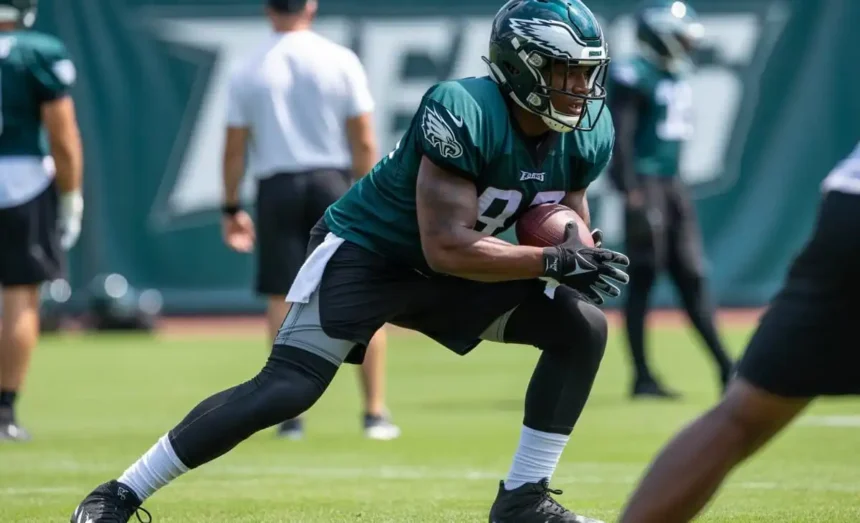
The eagles rookie trade attempt became one of the quiet but telling storylines of draft night. According to ESPN’s Dan Graziano, Philadelphia tried to move as high as No. 18 to secure Alabama linebacker Jihaad Campbell. They did not come close to that price point. However, they ultimately moved just one spot, from No. 32 to No. 31, to get their target.
That detail matters. It signals intent. The Eagles were not reacting to the board. They were pursuing a specific vision for their defense.
Why the Eagles Rookie Trade Attempt Started Early
The eagles rookie trade attempt reportedly began well before pick No. 31 was on the clock. Philadelphia explored scenarios to climb into the middle of the first round. This was not panic. It was preparation. Front offices often map out multiple trade pathways in advance. In this case, the Eagles identified Campbell as a linebacker worth aggressive positioning.
Although they failed to reach No. 18, their early initiative demonstrates conviction. They were willing to pay for alignment with their draft board.
Jihaad Campbell’s Fit in Philadelphia’s Defensive Scheme
Campbell arrives from Alabama with SEC-tested instincts and range. At inside linebacker, recognition is everything. Defensive coordinator Vic Fangio emphasized that growth in 11-on-11 situations will determine how quickly Campbell earns trust. Diagnosing run versus pass in real time is foundational.
The Eagles value versatility at the second level. Campbell’s athleticism allows him to flow sideline to sideline. However, reaction speed in complex NFL offenses will define his immediate impact.
Practice Reps and Early Opportunity After the Eagles Rookie Trade Attempt
Opportunity sometimes comes from circumstance. With veteran linebacker Zack Baun missing time due to a back issue, Campbell has received meaningful practice reps. He has even worked with the first team in certain packages. That exposure accelerates development.
Repetition against starting offensive units sharpens processing speed. For rookies, mental adjustment often matters more than physical ability. Therefore, these early reps could shape Campbell’s rookie trajectory significantly.
The Strategic Value Behind the Trade-Up Mindset
The eagles rookie trade attempt was not about flash. It was about depth sustainability. Philadelphia’s defense lost several contributors from its championship roster. Replenishing leadership and athletic range at linebacker became a priority.
Trading up, even slightly, ensured control. Instead of hoping Campbell would fall to No. 32, the Eagles eliminated uncertainty. In competitive roster construction, minimizing variables can be as valuable as acquiring talent itself.
How Championship Context Shapes Rookie Expectations
The Eagles are defending Super Bowl champions. That reality changes everything. Rookies joining elite rosters do not enter rebuilding environments. They enter pressure environments. Expectations are immediate.
However, championship teams also offer structure. Veteran leadership, coaching continuity, and defined schemes provide guardrails. Campbell benefits from that stability. He does not need to carry the defense. He needs to contribute within it.
What Vic Fangio Wants to See Next
- Faster run-pass diagnosis in live 11-on-11 scenarios
- Improved gap discipline against power rushing schemes
- Communication consistency with defensive linemen
- Confident coverage drops against tight ends
Fangio’s emphasis is technical, not emotional. Improvement is measurable. If Campbell masters these details, his playing time will naturally expand.
Case Study: Trading Up for Defensive Impact
History provides useful perspective. In 2012, Seattle traded up for linebacker Bobby Wagner. He became a cornerstone of a championship defense. While every prospect differs, the lesson remains consistent. Targeted aggression in the draft can reshape defensive identity.
The eagles rookie trade attempt reflects similar logic. When a front office believes a player fits culturally and schematically, controlled risk can yield long-term stability.
The Defensive Identity Transition After the Eagles Rookie Trade Attempt
Philadelphia’s offense remains largely intact from its title run. The defense, however, has experienced turnover. New contributors must replicate intensity and cohesion. Campbell represents more than depth. He represents transition.
Inside linebackers anchor communication. They adjust alignments. They read offensive shifts. Therefore, Campbell’s development intersects directly with the Eagles’ defensive continuity.
Risk, Reward, and Draft Capital Management
Trading up always carries risk. Draft capital is finite. Each pick surrendered limits future flexibility. Yet Philadelphia minimized cost by moving only one slot. That efficiency matters.
Front offices often attempt aggressive jumps and settle for measured ones. In this instance, the eagles rookie trade attempt evolved into a calculated micro-move. The Eagles achieved their objective without overpaying.
Long-Term Projection for Campbell
Short term, Campbell may rotate situationally. Long term, expectations are larger. The Eagles did not explore half the first round casually. They believed in upside.
If Campbell refines diagnostic speed and maintains discipline, he could anchor the defense for years. First-round linebackers are evaluated differently. Leadership, not just tackles, defines success. Philadelphia drafted with that horizon in mind.
What This Means for the NFC Landscape
Within the NFC, defensive adaptability matters. Offenses are dynamic and creative. Linebackers must match pace and intelligence. The eagles rookie trade attempt signals Philadelphia’s commitment to speed and recognition at the second level.
If Campbell matures quickly, the Eagles sustain competitive advantage. If growth takes time, depth still protects them. Either way, the move reflects strategic foresight rather than desperation.
Conclusion: Why the Eagles Rookie Trade Attempt Matters
The eagles rookie trade attempt tells a story beyond draft positioning. It reveals clarity. Philadelphia identified Jihaad Campbell as a foundational piece and acted accordingly. They attempted an ambitious climb, then executed a precise adjustment.
Championship teams rarely rely on chance. They rely on conviction. By securing Campbell, the Eagles reinforced their defensive blueprint. Whether he becomes an every-down force immediately or gradually grows into that role, the intent behind the move is clear. Philadelphia values preparation over reaction. And in the NFL, that mindset often separates contenders from champions.
FAQs
- Why did the Eagles try to trade up in the draft?
They targeted Jihaad Campbell early and explored higher picks to secure him before settling at No. 31. - Did the Eagles give up significant draft capital?
No. They ultimately moved up just one spot, limiting long-term cost. - What position does Jihaad Campbell play?
He is an inside linebacker known for athletic range and defensive versatility. - Will Campbell start immediately?
Not necessarily, but early practice reps suggest he could see meaningful playing time. - Why is this trade attempt important long term?
It reflects strategic planning and a commitment to sustaining defensive identity.