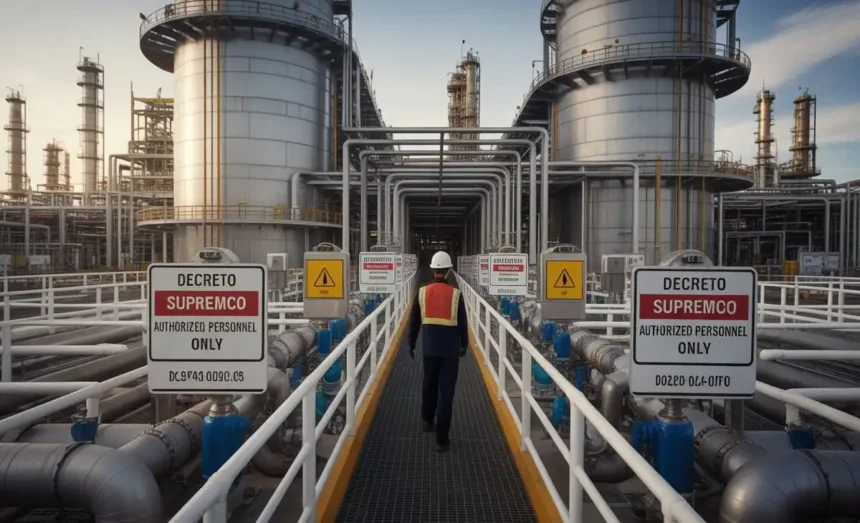
Industrial regulation rarely attracts public attention. Yet some legal frameworks quietly shape daily life in powerful ways. Decreto Supremo 160 is one of those frameworks. It is not simply a technical decree for engineers or compliance officers. It is a national safeguard designed to prevent industrial accidents, protect environmental systems, and reduce large-scale public health risks before they materialize.
While often discussed in regulatory language, its real-world impact reaches communities, workers, emergency systems, and ecosystems. Understanding what Decreto Supremo 160 actually does helps clarify why preventive governance matters more than reactive crisis management.
What Is Decreto Supremo 160 and What Does It Regulate?
At its core, Decreto Supremo 160 is an executive regulation issued under presidential authority to establish mandatory operational and safety standards in high-risk sectors. It is most closely associated with combustible fuels, hazardous materials handling, and industrial infrastructure systems that carry elevated public risk.
Rather than functioning as a passive rulebook, it operates as a risk containment structure. It defines how substances are produced, transported, stored, and distributed. The objective is simple but uncompromising: prevent mechanical failure, human error, or weak oversight from escalating into fires, explosions, contamination events, or mass exposure incidents.
The Preventive Philosophy Behind Decreto Supremo 160
The foundation of Decreto Supremo 160 is prevention. It does not prioritize response after harm occurs. Instead, it mandates that risk be identified, engineered out, and structurally controlled before operations begin.
This philosophy includes safety margins in design, redundant containment systems, strict inspection cycles, and documented operational discipline. The decree assumes that failure is possible and builds layers of defense to stop cascading consequences. When prevention works properly, the public never sees the crisis that could have occurred.
How Decreto Supremo 160 Supports Public Health
Public health does not begin in hospitals. It begins at the source of exposure. Industrial systems that handle volatile fuels and hazardous substances can directly affect air quality, soil stability, and water safety. Weak controls create chronic health risks that may take years to surface.
By enforcing containment, inspection, and controlled handling procedures, Decreto Supremo 160 reduces the likelihood of toxic exposure and environmental degradation. It limits long-term respiratory risk, prevents groundwater contamination, and reduces the chance of acute injury from large-scale industrial accidents. In this sense, it functions as upstream health infrastructure.
Industrial Safety as Population-Level Protection
Industrial regulations are often framed as economic burdens. In reality, they are population-level safeguards. When storage systems leak or fuel transport fails, nearby communities experience the consequences first. Fires, explosions, and toxic releases do not remain confined to corporate boundaries.
Decreto Supremo 160 treats industrial safety as a public responsibility rather than a private choice. By mandating compliance standards, it protects workers, neighboring residents, and emergency responders. It reduces strain on healthcare systems and preserves environmental stability that supports agriculture and urban life.
Core Compliance Requirements Under Decreto Supremo 160
The structure of Decreto Supremo 160 defines clear compliance expectations across operational chains. These requirements typically include:
- Mandatory facility design standards with engineered safety margins
- Regular inspection and maintenance documentation
- Secure storage and transport procedures for hazardous materials
- Certified training for operators and contractors
- Emergency response coordination protocols
These requirements are not optional guidelines. They are enforceable obligations designed to eliminate preventable risk before operations scale.
Accountability and Legal Responsibility
One of the strongest features of Decreto Supremo 160 is accountability. Responsibility is not abstract. It is distributed clearly across facility owners, operators, transport providers, maintenance entities, and contractors.
Failure to comply is treated as preventable negligence rather than an unfortunate accident. This legal framing shifts cost back to those who manage risk. It discourages corner-cutting and incentivizes long-term safety planning. Accountability strengthens trust because it removes ambiguity about who is responsible when systems fail.
Why Decreto Supremo 160 Remains Relevant Today
Industrial systems are evolving. Urban areas are expanding closer to fuel infrastructure. Climate variability introduces new stress factors, including extreme heat and flooding. Supply chains operate faster and at larger scales.
Despite these changes, Decreto Supremo 160 remains relevant because it is principle-based. Its focus on redundancy, containment, inspection, and documentation scales with complexity. As infrastructure becomes denser, preventive regulation becomes even more critical. Without structured safeguards, small technical failures could trigger widespread consequences in interconnected systems.
Real Case Example: Risk Avoided Through Compliance
Consider a mid-sized fuel distribution facility operating near a growing residential zone. During routine inspection required under regulatory compliance, structural weakness was identified in a storage tank seam. The defect was minor but capable of expanding under temperature stress.
Because inspection cycles were mandatory, the issue was corrected before a leak developed. Had it gone unnoticed, soil contamination and fire risk could have affected surrounding neighborhoods. This example demonstrates how preventive frameworks reduce invisible risk long before harm becomes visible.
Common Misconceptions About Decreto Supremo 160
Some misunderstand the purpose of industrial regulation. It is often described as bureaucratic delay or unnecessary constraint. These assumptions overlook long-term cost analysis.
- It does not exist to slow industry; it prevents catastrophic failure and litigation.
- It does not apply only to corporations; communities benefit directly from safer systems.
- It is not outdated; its preventive structure adapts with technical updates.
When examined through risk management logic, its function becomes clearer and more defensible.
The Cost of Weak Enforcement
A regulation’s strength depends on consistent enforcement. Without inspection, documentation, and penalties for non-compliance, safety standards become symbolic rather than structural.
Weak enforcement leads to preventable incidents framed as unpredictable accidents. Communities bear environmental exposure. Emergency services absorb preventable burdens. Public trust erodes when oversight fails. The absence of visible disaster does not guarantee safety; it may signal unreported or accumulating risk beneath the surface.
Decreto Supremo 160 as a Model for Preventive Governance
The preventive philosophy embedded in Decreto Supremo 160 offers a broader governance lesson. Waiting for harm statistics before acting often leads to irreversible consequences. Preventive regulation relies on engineering foresight and historical risk modeling.
This framework can apply beyond fuel systems. Infrastructure resilience, chemical storage, and environmental hazard management benefit from the same upstream approach. Preventive governance is less dramatic than crisis response, but it is far more effective in protecting long-term stability.
Balancing Industrial Growth and Public Protection
Economic development and safety are often framed as opposing forces. In practice, stable safety frameworks support sustainable growth. Investors favor predictable regulatory environments. Communities support industries that demonstrate accountability.
Decreto Supremo 160 creates operational clarity. Companies know the standards. Communities know protections exist. Growth built on preventive discipline is more resilient than growth built on reactive damage control.
Conclusion
Decreto Supremo 160 demonstrates that the most powerful safeguards are built before crisis occurs. Its strength lies in structural prevention, clear accountability, and enforceable standards that eliminate avoidable risk. By regulating hazardous systems responsibly, it protects public health, environmental integrity, and industrial continuity at the same time.
In increasingly complex societies, preventive regulation is not optional. It remains a quiet but essential pillar of collective safety, proving that disasters prevented are the most important successes we rarely see.
Frequently Asked Questions (FAQs)
- What is the main purpose of Decreto Supremo 160?
It establishes mandatory safety standards to eliminate preventable risk in hazardous industrial systems. - Does it directly affect public health?
Yes. By reducing exposure and accident risks, it protects communities and workers upstream. - Who must comply with Decreto Supremo 160?
Facility owners, operators, contractors, and transport providers share defined legal responsibility. - Why is enforcement important?
Without inspection and accountability, safety standards lose effectiveness and risk increases. - Is Decreto Supremo 160 still relevant today?
Absolutely. As infrastructure grows more complex, preventive regulation becomes even more essential.