Industrial revolutions rarely announce themselves quietly. Yet in northern Sweden, a coordinated transformation is unfolding with unusual precision. BodenXT is not a single factory, not a marketing slogan, and not a short-term stimulus plan. It is a multi-decade municipal strategy designed to compress two decades of growth into one generation.
At its core, BodenXT aligns heavy industry, renewable energy, housing, workforce expansion, digital infrastructure, and community planning into one synchronized framework. The objective is clear: build a globally competitive green industrial hub while simultaneously developing a resilient and livable city.
What Is BodenXT and Why Was It Created?
BodenXT is a long-range transformation platform initiated by the municipality of Boden. It was created in response to a rare economic window driven by green industrial investment in northern Sweden. Instead of reacting to rapid growth, local leadership chose to orchestrate it.
The strategy coordinates industrial timelines with housing supply, workforce training, infrastructure upgrades, and public services. By planning proactively, Boden avoids the chaotic expansion often seen in industrial boom towns. The guiding principle is simple: industry succeeds only when society grows alongside it.
The Green Re-Industrialization Moment Behind BodenXT
Europe is undergoing a structural energy transition. Renewable electricity capacity in northern Sweden, particularly hydro and wind, created a strategic advantage. Access to land, cold climate efficiency, and proximity to European markets amplified that opportunity.
BodenXT emerged to capture this moment intentionally. Rather than allowing fragmented development, the municipality designed a coordinated model. This prevented housing shortages, grid overload, and labor gaps. The transformation is not reactive growth. It is synchronized expansion anchored in long-term industrial decarbonization.
The Industrial Core: Green Steel at Scale
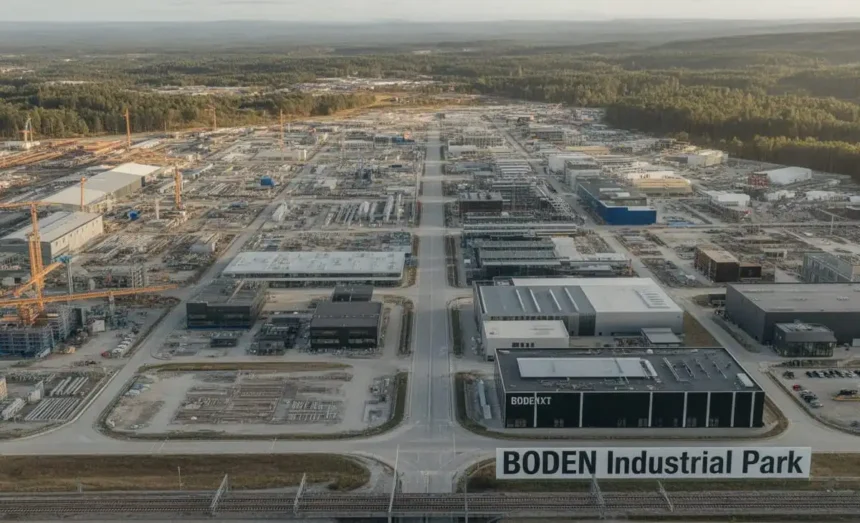
At the center of BodenXT stands a hydrogen-based green steel initiative inside the 550-hectare industrial park. Traditional steel production accounts for roughly 7–8% of global carbon emissions. The new production model replaces coal with renewable hydrogen in direct reduction processes.
The facility targets approximately five million tonnes of annual steel production. Carbon emissions are expected to decrease by up to 95% compared to conventional blast furnaces. Around 2,000 direct jobs are projected by 2030. This is not pilot sustainability. It is industrial decarbonization executed at scale.
Infrastructure Designed for Long-Term Expansion
Industrial growth collapses without strong infrastructure. BodenXT integrates transport, rail access, grid capacity, digital connectivity, and subsurface utilities simultaneously. Planning occurred above and below ground to reduce future reconstruction costs.
The railway connection to the industrial park was completed efficiently, strengthening export logistics. Fiber networks, water systems, and energy distribution were engineered in parallel. This integrated model reduces bottlenecks and increases long-term resilience. Infrastructure was not retrofitted after expansion. It was built as part of the transformation design.
Population Growth and Urban Renewal
For decades, many European municipalities faced demographic stagnation. BodenXT reverses that trend. Skilled workers, engineers, logistics professionals, and entrepreneurs are relocating due to industrial expansion.
Population growth supports new housing development, expanded schools, retail activity, and a stronger tax base. Urban planning reforms accelerated zoning and building processes to keep pace with demand. Growth is not limited to industrial zones. It reshapes daily life, community design, and long-term municipal stability.
BodenXT by the Numbers
The transformation becomes clearer when viewed through measurable impact:
- Industrial Land Area: ~550 hectares
- Steel Production Target: ~5 million tonnes annually
- Emissions Reduction: Up to 95% lower than traditional steelmaking
- Projected Direct Jobs: ~2,000 by 2030
- Energy Model: Renewable electricity + green hydrogen
These figures confirm that BodenXT operates at full industrial scale. It is not an experimental policy. It is structural re-engineering supported by measurable commitments.
Five Structural Pillars of BodenXT
The strategy operates through five coordinated pillars:
- Skills Supply: Partnerships with universities and vocational institutes secure hydrogen and metallurgy expertise.
- Living & Housing: Accelerated development prevents residential bottlenecks.
- Business Ecosystem: SMEs integrate into the industrial cluster.
- Above-Ground Infrastructure: Transport, digital, and energy networks expand.
- Below-Ground Systems: Subsurface utilities are planned for scalability.
Each pillar functions independently but operates under one strategic umbrella, ensuring synchronized progress rather than fragmented growth.
Energy Advantage: The Renewable Backbone
Access to fossil-free electricity is foundational. Northern Sweden’s hydro and wind resources provide large volumes of stable renewable power. Hydrogen-based steel production depends on this supply.
Cold climate conditions reduce cooling loads and enhance energy efficiency in industrial processes. Grid stability lowers volatility risk. Energy is not an auxiliary component of BodenXT. It is the economic catalyst enabling competitive green heavy industry at global scale.
Economic Multiplier Effects Beyond Steel
While steel anchors phase one, secondary sectors are emerging. Hydrogen innovation, logistics optimization, digital monitoring systems, smart agriculture pilots, and industrial edge computing are expanding around the core.
These adjacent ecosystems diversify economic risk. If global steel cycles fluctuate, technological and service sectors provide balance. BodenXT builds layered resilience instead of single-industry dependence. Industrial transformation becomes an ecosystem rather than a silo.
Real Case Example: Coordinated Growth in Practice
A logistics firm relocated operations near the industrial park to serve expanding steel production. Instead of facing labor shortages, the company benefited from coordinated vocational training programs developed under BodenXT.
Simultaneously, housing construction ensured employees could relocate without delay. Transport routes were already operational. This alignment reduced ramp-up friction and accelerated operational readiness. The example illustrates how synchronized planning reduces growth barriers and increases economic stability.
Risk Factors and Structural Challenges
No transformation is risk-free. BodenXT faces challenges including European energy price volatility, hydrogen infrastructure maturity timelines, global steel demand cycles, and workforce mobility constraints.
However, early infrastructure investment and municipal coordination reduce systemic fragility. By planning energy, housing, workforce, and transport together, BodenXT lowers the probability of cascading bottlenecks. Proactive design mitigates many risks that undermine rapid industrial expansion elsewhere.
Global Significance of BodenXT
The global industrial sector must decarbonize. Many regions discuss transition. Few implement it at municipal scale with synchronized social planning.
BodenXT offers a replicable template: anchor transformation in renewable energy, align policy with industrial timelines, secure workforce pipelines early, and integrate urban growth with infrastructure design. If successful long term, Boden becomes a benchmark for green re-industrialization strategies worldwide.
The Long-Term Outlook Beyond 2030
By 2030, full-scale steel production is expected. Population growth will reshape housing stock and infrastructure density. The long-term test lies in durability through economic downturns.
Because BodenXT builds a layered economic base rather than relying on a single facility, it increases adaptive capacity. Strategic integration remains its defining strength. Sustainable competitiveness depends on maintaining that coordination beyond initial investment cycles.
Conclusion
BodenXT represents structural transformation rather than symbolic policy. Heavy industry is decarbonizing. Infrastructure is expanding in sync. Population growth is returning to a previously stagnant municipality. Renewable energy underpins the entire model.
If execution remains disciplined, BodenXT will stand as a defining example of how climate transition and economic expansion can advance together. It proves that proactive municipal coordination can turn industrial acceleration into long-term societal resilience.
Frequently Asked Questions (FAQs)
- What is BodenXT?
BodenXT is a long-term municipal transformation strategy accelerating green industry and city development in Boden, Sweden. - How large is the industrial park?
The Boden Industrial Park covers approximately 550 hectares of planned green industrial land. - How much steel will be produced annually?
The projected target is around five million tonnes per year at full production. - How significant is the emissions reduction?
Up to 95% lower CO₂ emissions compared to traditional coal-based steelmaking. - How many jobs are expected?
Around 2,000 direct industrial jobs by 2030, plus indirect employment growth across sectors.