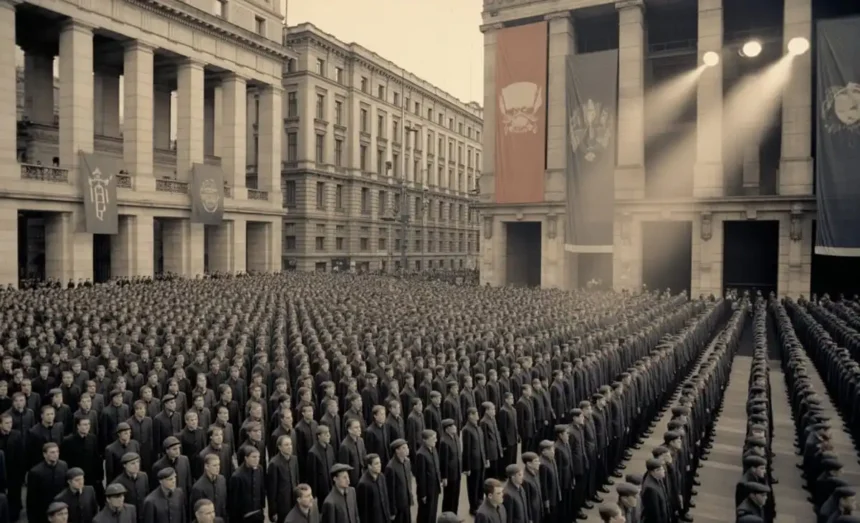
The term Fascisterne carries significant historical and political weight in Denmark and across Europe. It is not a casual label. Instead, it refers to individuals aligned with fascist ideology—an authoritarian, ultra-nationalist political system that shaped the 20th century in profound and destructive ways.
Understanding Fascisterne requires more than a dictionary definition. It demands historical context, ideological clarity, and awareness of long-term social consequences. Therefore, this article explores its linguistic roots, political foundations, psychological mechanisms, and enduring relevance in modern democratic discourse.
The Linguistic Meaning of Fascisterne
The word Fascisterne is the Danish plural form of “the fascists.” It originates from the term “fascism,” which itself derives from the Latin fasces, a bundle of rods symbolizing authority and unity in ancient Rome. The symbolism later inspired modern political movements seeking centralized power.
In Denmark, Fascisterne is used primarily in historical or academic discussion. It refers to groups adhering to fascist ideology rather than serving as a neutral descriptor. Consequently, the word carries moral seriousness shaped by European history.
Core Ideological Foundations Behind Fascisterne
To understand Fascisterne, we must first clarify fascism’s defining traits. Political scholars identify several structural principles that characterize fascist systems:
- Absolute leadership centered on a single authority figure
- Suppression of opposition and independent media
- Extreme nationalism linked to cultural or racial narratives
- Militarization of society and political life
- Rejection of democratic pluralism
These elements collectively concentrate power and dismantle institutional safeguards. As a result, dissent becomes criminalized, and political diversity disappears.
Fascisterne in Denmark: Historical Context
Fascist movements appeared in Denmark during the interwar period. The most notable group was the Danmarks Nationalsocialistiske Arbejderparti, which sought ideological alignment with Nazi Germany. However, it never achieved mass national dominance.
During the German occupation of Denmark in World War II, collaborationist elements existed. After liberation, Danish society strongly rejected fascist alignment. Therefore, Fascisterne became historically associated with betrayal and anti-democratic extremism. This memory continues to shape the term’s meaning today.
Political Mechanisms Used by Fascisterne
Fascist movements did not gain influence randomly. They followed identifiable strategies designed to consolidate power and weaken democracy:
- Exploiting economic instability and social fear
- Amplifying nationalist rhetoric
- Framing democracy as ineffective
- Using intimidation or paramilitary presence
- Controlling media narratives
These mechanisms allowed authoritarian leadership to normalize extreme policies. Gradually, institutional checks eroded until opposition structures collapsed.
Psychological Drivers Behind Fascist Support
Authoritarian ideologies often rise during periods of uncertainty. Research in political psychology suggests that fear and identity insecurity create fertile ground for movements labeled Fascisterne. When people perceive economic or cultural threats, strong leadership narratives become appealing.
Moreover, fascist rhetoric simplifies complex realities into emotionally powerful messages. It offers certainty during instability. Consequently, citizens may accept reduced freedoms in exchange for perceived order and security.
Impact on Democratic Institutions
Fascist systems systematically weaken democratic institutions. Independent courts, free press, and parliamentary oversight become obstacles rather than safeguards. Therefore, they are gradually dismantled.
Instead of debate, propaganda replaces discourse. Elections, if maintained, become symbolic rather than competitive. Over time, institutional erosion transforms governance into centralized rule. The lesson is clear: democratic structures require constant protection to prevent concentration of unchecked authority.
Public Health and Social Consequences
Fascist regimes historically reshaped healthcare and social systems to serve ideological goals. In Nazi Germany, public health policy was politicized to promote racial doctrines. Consequently, medical ethics suffered severe distortion.
Healthcare professionals who resisted faced repression. Communities deemed undesirable were excluded from services. This demonstrates that fascism extends beyond politics. It influences healthcare delivery, professional standards, and population well-being.
Mental Health Under Authoritarian Rule
Long-term exposure to authoritarian governance creates psychological strain. Surveillance culture and suppression foster chronic anxiety. Furthermore, trauma resulting from political persecution often persists across generations.
Studies of post-authoritarian societies show elevated distrust and reduced civic engagement. Fear-based conformity becomes normalized. Although economic conditions may vary, psychological damage often lingers long after regimes collapse.
Modern Usage: Precision and Responsibility
Today, Fascisterne sometimes appears in political debate as a rhetorical insult. However, scholars emphasize analytical precision. Not every nationalist movement qualifies as fascist.
Overuse dilutes historical meaning. Therefore, distinguishing between classical fascism and modern populist authoritarianism is essential. Responsible usage protects historical clarity and prevents conceptual confusion in contemporary analysis.
Why Studying Fascisterne Still Matters
The study of Fascisterne remains relevant because democratic systems remain vulnerable during crises. Economic shocks, cultural anxiety, and political polarization can weaken institutions.
Historical examination offers practical lessons. Independent media, judicial oversight, and civic education serve as democratic safeguards. When these erode gradually, consequences may appear minor at first. However, cumulative decline can produce structural collapse.
Conclusion
Fascisterne represents more than a linguistic term. It signifies a documented ideological system characterized by authoritarian leadership, suppression of dissent, and extreme nationalism. Its historical legacy in Denmark and Europe remains deeply embedded in collective memory.
Understanding Fascisterne requires analytical rigor rather than emotional exaggeration. By studying its origins, mechanisms, and consequences, societies strengthen democratic resilience. History does not inevitably repeat itself. However, informed citizens are better equipped to recognize patterns and protect institutional integrity.
Frequently Asked Questions
- What does Fascisterne mean?
It is the Danish plural term for “the fascists,” referring to individuals aligned with fascist ideology. - Did Fascisterne gain power in Denmark?
Fascist groups existed but never achieved dominant national control. They were widely rejected after World War II. - Is fascism the same as Nazism?
Nazism was a specific form of fascism developed in Germany. All Nazis were fascists, but not all fascists were Nazis. - What defines fascist ideology?
It includes authoritarian leadership, suppression of opposition, extreme nationalism, and rejection of democratic pluralism. - Why is the term controversial today?
Because it refers to regimes responsible for repression and war, misuse in debate can weaken historical accuracy.